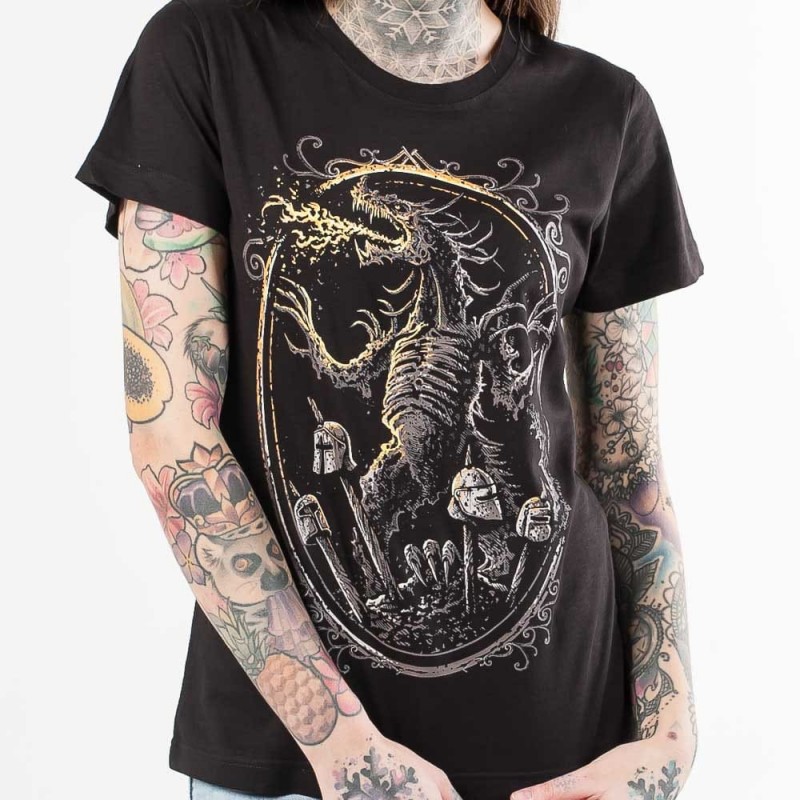

100% cotton T-shirt, 145g/m²
Available in sizes from XS to 2XL
Print made using the Direct-to-Film (DTF) method
Who was Melusine?
Melusine is a woman with the tail of a fish—sometimes a serpent or even a dragon. But she is not a mermaid. Her legend comes from medieval Europe and likely reached Silesia in the 14th century, when the rulers of Cieszyn became vassals of the Roman emperors and the Bohemian Luxembourg dynasty. Melusine is a tragic figure—but how did she become one?
The story begins with Elinas, a nobleman from England or Scotland, who had recently lost his wife. To escape his grief, he went hunting. In the forest, at the Well of Desire, he heard a beautiful song sung by a mysterious woman—Pressine. Captivated, he invited her to his hunting lodge, where they spent the night talking. Elinas fell in love and asked for her hand in marriage.
Pressine agreed—on one condition: he must never see her during the birth of their children. Elinas, deeply in love, promised. The marriage was happy, and in time Pressine gave birth to triplet daughters: Melusine, Melior, and Palatyne.
But Elinas, overjoyed at the birth, forgot his vow and rushed to see them. His broken promise enraged Pressine, who fled with the girls to the Isle of Avalon, leaving Elinas behind in despair. Each day, she took her daughters to a mountain where they could look upon their father’s kingdom, reminding them that they could have lived there—had he kept his word.
When the girls turned fifteen, Pressine revealed the truth. Melior and Palatyne forgave their father, but Melusine, full of anger, plotted revenge. She convinced her sisters to trap Elinas in a mountain along with his treasure. But when they returned to their mother, Pressine was horrified. The daughters had destroyed the only happiness she had ever known—her love for Elinas.
As punishment, Pressine condemned them. Melior was imprisoned in a castle, Palatyne sealed in the mountain with their father, and Melusine received the harshest fate of all: every Saturday, her lower body would transform into that of a serpent. But there was hope—if a man agreed to marry her and swore never to see her on a Saturday, she could continue living as a woman. So long as he kept the promise, Melusine could build cities and fortresses, bear children, and establish a noble dynasty—the House of Lusignan. If he broke it, she would forever remain in her monstrous form.
Banished from Avalon under this curse, Melusine settled near a stream in the forests of France, not far from Poitiers. One day, she encountered a distraught nobleman, Raymondin, who had accidentally killed his uncle. Melusine comforted him and helped him navigate the situation. He fell in love and asked for her hand. She agreed—on the condition that she be left alone every Saturday. Raymondin promised.
For over ten years, their marriage thrived. Melusine brought him wealth, land, and power, and gave birth to ten children. But in time, Raymondin’s family began to gossip: Why was she never seen on Saturdays? Why did she avoid attending Mass?
Suspicious, Raymondin broke his vow. When he saw Melusine in her serpent-dragon form, he was horrified—and publicly called her a "false serpent," betraying her in the worst possible way. Heartbroken, Melusine lost all hope for a normal life.
In some versions of the legend, she escaped through a window as a dragon; in others, she leapt into a river and disappeared. It’s said she still appears at key moments—when a Lusignan castle changes hands, or when a family member dies.
One tale claims she eventually found others like herself and started a new life. In another, the curse became unbearable, and she begged her mother for a new body. Pressine, still unable to forgive, placed her in a man’s body—condemning her to live in pain until the end of time. Melusine could only shift back into her old form when returning to her ancestral home, to fulfill the terms of the original curse.